Here is a small thing that happened to you today, nine times, and you didn't notice it once: your phone looked at your face and let you in. A quarter of a second. No typing, no thinking about it. 📱
Also today, four times, you typed a password out long enough for somebody in the next room to have a fair shot at it. Same phone. Same hands. Same day, usually within an hour of each other.
And the four are always the same four. Your email. Your bank. The work portal. And the one that is supposed to be holding all the others, which you also retype, because of course you do.
You have already made this decision. Twice.
Here is what I want to put in front of you, because I don't think it has ever once been framed this way for you. Both of those things are security decisions. One of them you made deliberately, on a good day, by turning a setting on. The other one you inherited, and you have never once had the meeting about it. 📝
They want you to call the typing a habit. I think that's wrong, and I think it's insulting. It isn't a habit. It's a decision you never made — and a decision you never made is the only kind of decision that can still be changed, this afternoon, for free. Heard?
Because here's the arithmetic nobody lays out. Your face unlock runs on a phone that already knows your face, on the device you're already holding in your hand, and it costs you nothing to use. Your passwords are the security on the accounts that hold your money, your identity, your benefits and your work. 🔐
You automated the lock that was never the problem and kept typing the ones that guard the house.
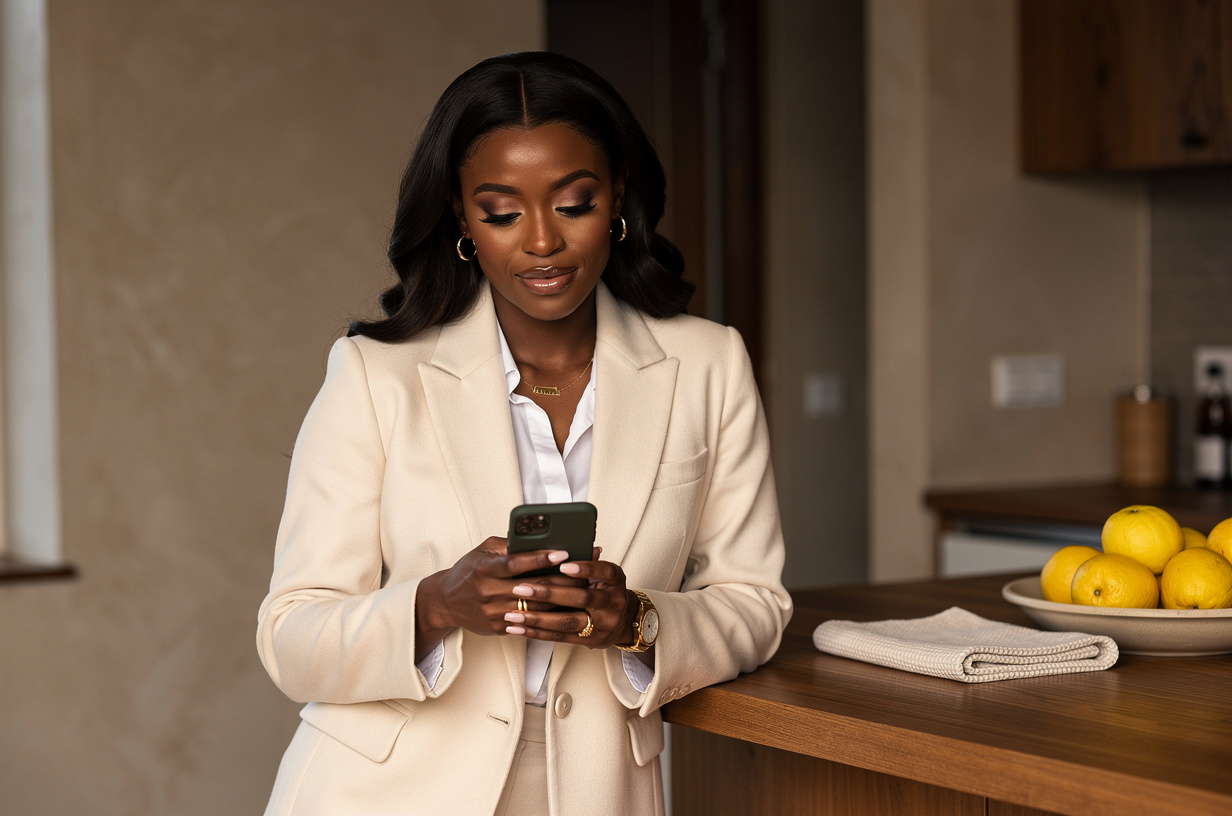
So the lock that was never the problem gets used without you. The ones guarding the house get said out loud to a phone on a kitchen counter at nine at night, which is the one moment of the day you are least able to hear yourself think.
Why it has stayed this way for so long
And the honest answer to why you haven't done anything about it is not that it's difficult. It's that it's boring, and it involves you being the single person in your own life responsible for a thing that punishes you for about a week the second you get it slightly wrong. 💅🏾

Which is a strange position to be in, when you run a business, manage money for a household, and are the person everybody else calls when a file is missing. Nobody is coming to fix this one. It has your name on it and it has had your name on it for years.
So here are the three questions I would ask. 1️⃣ Which four accounts did you type today, and what actually happens to you if somebody else got into each one? 2️⃣ If you lost the phone tomorrow, how many of those four would you have to reset from memory — and do you know which of them you made identical? 3️⃣ When you last changed a password, was it because something happened, or because a service told you to?
The answer to question three is the whole thing. It wasn't a decision you made. It was a notification you obeyed, and it came with the same six-character password you've used since 2019, because changing it meant remembering a new one — and remembering a new one at seven in the morning felt like a punishment.
Nobody is hiding this from you. The instructions are sitting right there and they are genuinely fine. It's just that they assume a version of you with more patience for paperwork than the one who exists at seven in the morning. 💡
What actually fixes it
One tool, one afternoon. You put every account into a single place that remembers them and types them for you, and the only password left in your head is one long one you will genuinely never forget. That is the entire thing. I am telling you that plainly because it is a great deal smaller than you have been imagining. 🧰
Then do the part nobody mentions, which is the part that actually makes it hold. Turn on two-factor authentication on the three accounts that matter most — the bank, the email, the work portal — and save those codes somewhere that is not the same device as the phone. Not because the codes are magic. Because they turn a stolen password into a locked door instead of an open one.
Total time, honestly: about forty minutes, and most of it is waiting for you to type old passwords you haven't touched in two years. You'll feel mildly foolish for roughly six of them. That is not a sign that you did it wrong. It is the sound of the whole thing being smaller than the dread. ⚡
What it feels like the first few weeks
Nothing, at first, which is exactly why people don't finish. There's no moment where your life changes and nobody sends you a congratulation for it. Then about ten days in, you catch yourself not thinking about passwords at all, and the strange part is what that absence feels like.
It feels like having handed somebody a jar and not watching it. 🌿
And there is a quieter thing underneath it that I don't want to skip past. The version of you who can hold every account in her own head is tired in a way she has never once been able to name, because there is no word for the tiredness of being the only person who knows the combination. You weren't forgetting passwords. You were carrying them.
There is one more thing this changes that nobody mentions, and it is the one I would actually put at the top. Today your accounts have exactly one point of failure and it is a thumbprint on a glass rectangle you carry everywhere. That is the part that should have been uncomfortable a long time ago. Once the passwords live somewhere that is not your memory, losing the phone stops being a catastrophe and becomes an afternoon. You will not feel brave about it. You will just notice, one day, that you are no longer bracing. 🔑
The takeaway
Today: name the four accounts you typed. Then set up one password manager and move them across. Forty minutes, one jar handed over, and one decision finally made on purpose instead of inherited.
You already trust your phone with your face. Give it your passwords too — that was the whole point of the thing. 💅🏾